
How to Tow a Trailer Safely for the First Time
Towing a trailer for the first time takes a little adjustment. Your vehicle is longer, heavier and will respond differently when accelerating, braking and turning. The most important thing is to give yourself more time and space than you normally would.
Before your first journey, make sure the trailer is suitable for your tow vehicle and that you understand the relevant weight limits. If you’re unsure, our Trailer Weights Explained: Payload, GTW and Towing Capacity guide covers the figures you need to check, while What Driving Licence Do You Need to Tow a Trailer? explains current UK licence entitlement.
Once those basics are covered, the next step is getting used to how the trailer behaves on the road.

Before You Tow for the First Time
Your first towing journey doesn’t need to be the most difficult one.
If possible, choose a familiar route and avoid particularly busy roads until you’ve had a chance to get used to the trailer. Allow plenty of time for the journey so you’re not rushing, particularly if you’ll need to manoeuvre the trailer when you arrive.
Before setting off:
- Adjust your mirrors so you have a clear view behind the trailer.
- Familiarise yourself with the trailer’s width and length, particularly if it’s considerably larger than your tow vehicle.
- Plan your route, looking out for narrow roads, tight entrances or other potential difficulties.
- Practise somewhere suitable if you’ve never manoeuvred a trailer before.
- Know where you’ll park or unload when you reach your destination, if possible.
There are also a number of physical checks to complete before every journey, including the coupling, tyres, lights and load security. We’ll cover these separately in our Pre-Journey Trailer Safety Checklist rather than repeating them here.
How Does Driving Change When You’re Towing a Trailer?
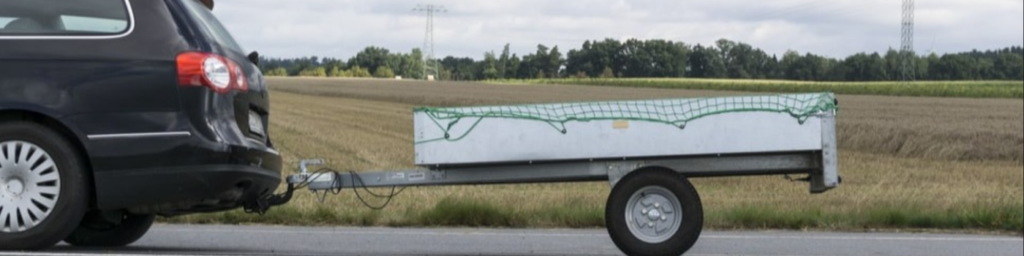
Even a relatively small trailer changes the dimensions and behaviour of your vehicle. Larger or more heavily loaded trailers make those differences more noticeable.
For a first-time tower, there are four main changes to get used to:
| Normal Driving | Towing a Trailer |
| You’re familiar with the vehicle’s length | You need to account for the trailer behind you |
| Acceleration is predictable | Additional weight can make acceleration slower |
| You know how the vehicle responds under braking | You need to anticipate slowing and stopping earlier |
| The rear wheels follow a familiar path through a turn | Trailer wheels can take a tighter path through corners |
None of these require you to completely change the way you drive. They simply mean planning further ahead and making your inputs more gradual.
You’ll also need to use your mirrors more frequently. Get into the habit of checking where the trailer is positioned, particularly before turning, changing direction or moving around an obstruction.
Pulling Away With a Trailer
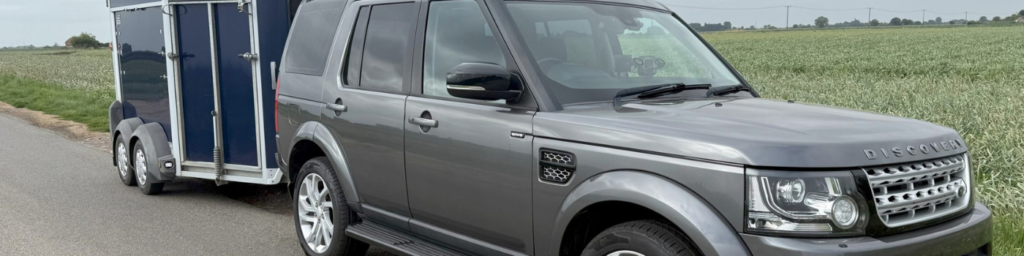
Take your time when you first start moving. Accelerate progressively rather than trying to get up to speed quickly. Depending on the trailer and load, the tow vehicle may feel noticeably less responsive than it normally does.
This is particularly important when pulling onto a roundabout, joining a main road or moving out of a junction. A gap you’d normally use without hesitation may not be large enough when towing because the combination takes longer to move and clear the junction.
Your first few miles are also a good opportunity to get a feel for the trailer. Pay attention to how the vehicle accelerates, how much additional space you’re using and whether the trailer feels settled behind you.
If anything feels unusual, find somewhere safe to stop and check the trailer rather than continuing with the journey.
Cutlers Tip: Don’t allow traffic behind you to rush your decisions. Waiting for a larger gap or taking a turn more slowly is far better than attempting a manoeuvre before you’re comfortable with it.
Braking Safely When Towing
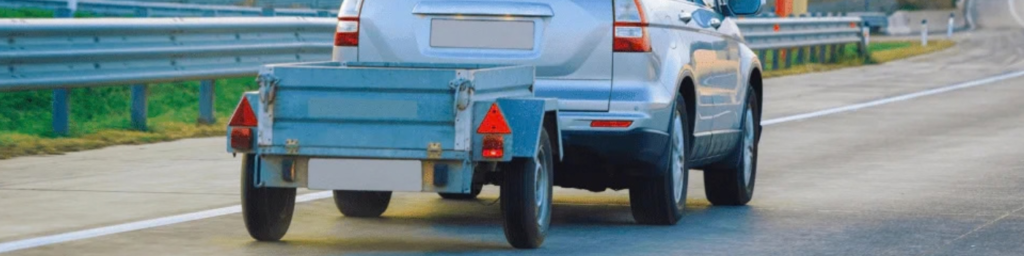
The extra weight behind your vehicle means you should think about slowing down earlier than you would during normal driving.
Look well ahead for junctions, roundabouts, queues and changes in traffic speed. Coming off the accelerator sooner and braking progressively gives the whole combination more time to slow down smoothly.
You should also increase the distance between yourself and the vehicle ahead. That extra space gives you more time to react if traffic suddenly slows.
Poor weather makes this even more important. Wet, icy or otherwise slippery roads can increase stopping distances, so adjust your speed and following distance to suit the conditions.
Some trailers have their own braking system while lighter trailers may be unbraked. We’ve explained how these systems differ and when they’re required in Braked vs Unbraked Trailers: Which Do You Need? For the driver, the principle remains the same: look ahead, leave more room and avoid unnecessarily harsh braking.
How to Corner Safely With a Trailer
Turning is one of the first differences you’ll notice when towing.
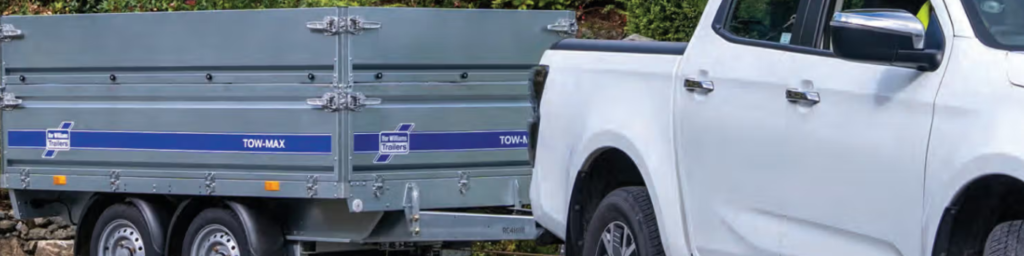
The trailer doesn’t follow exactly the same path as your tow vehicle. As you turn, its wheels generally travel on a tighter line. This is often referred to as the trailer cutting in.
Imagine you’re making a left turn into a narrow entrance. The tow vehicle may comfortably clear the kerb or gatepost, but the trailer behind you will follow a tighter route towards the inside of the turn.
That’s why you need to think about the position of the trailer wheels, not just whether the tow vehicle itself has cleared the obstacle.
When approaching a tighter turn:
- Reduce your speed before entering it.
- Give yourself more room where it is safe to do so.
- Keep checking the trailer’s position in your mirrors.
- Allow extra clearance around kerbs, walls, parked vehicles and gateposts.
- Make smooth steering inputs rather than suddenly correcting your line.
The longer the trailer, the more noticeable this difference can become. It’s particularly relevant when entering yards, farms, building sites, driveways or other locations where space is restricted.
If you’re unsure whether you’ll clear something, stop and check rather than guessing. There’s no benefit to rushing a tight manoeuvre, especially when you’re still learning how the trailer follows your vehicle.
Once you’ve become comfortable with pulling away, braking and turning, the next skill to tackle is the one that tends to concern new towers most: reversing a trailer.
How to Reverse a Trailer
Reversing is often the part of towing that takes the most practice. The trailer reacts differently to the direction you’re steering, and once it starts turning, relatively small steering movements can quickly change its angle.
The best way to learn is slowly and somewhere with plenty of room.
Start with the tow vehicle and trailer as straight as possible. Reverse at a very low speed and make small steering adjustments, watching the trailer carefully in your mirrors.
As you get used to it:
- Keep your movements small. Large steering inputs can quickly put the trailer at a difficult angle.
- Use both mirrors. This helps you judge the trailer’s position rather than relying on one side.
- Take your time. Reversing becomes much easier when everything is happening slowly.
- Pull forward and reset if necessary. Don’t keep trying to correct a manoeuvre that has already gone wrong.
Use someone to guide you where appropriate and make sure you can clearly see or communicate with them throughout the manoeuvre.
If you’re reversing into a tight entrance or somewhere with obstacles, stop and get out to check your surroundings whenever you’re unsure. For a first-time tower, pulling forward and starting again is completely normal. Even experienced drivers will reset a manoeuvre when it gives them a better approach.
Cutlers Tip: Practise reversing before you’re in a situation where you have to get it right. An empty yard or another suitable open space gives you a chance to understand how steering affects the trailer without the pressure of a narrow gateway or busy site.
Towing on Motorways and Faster Roads
Higher speeds require more awareness of the trailer and the traffic around you.
For cars towing trailers, the national speed limit is 50mph on single carriageways and 60mph on dual carriageways and motorways. Lower signed limits still apply, and the speed limit is a maximum rather than a target.
On a motorway, keep left unless you’re overtaking and give yourself plenty of time before changing lanes. Remember that your trailer still needs to clear the vehicle you’ve passed before you move back across.
There is also an important lane restriction for first-time towers to know: a vehicle drawing a trailer must not use the right-hand lane of a motorway with three or more lanes, except in prescribed circumstances.
Strong winds can make towing more difficult, particularly with larger or high-sided trailers. Passing or being passed by large vehicles can also affect the airflow around your trailer, so keep your steering controlled and avoid sudden movements. Official UK driving standards specifically identify strong winds as a hazard when towing high-sided trailers.

Towing Up and Down Hills
The effect of additional weight often becomes more obvious on hills. When travelling uphill, expect acceleration to be slower than it would be without a trailer. Look ahead and plan accordingly rather than accelerating aggressively to try to maintain your normal pace.
Descending a hill requires just as much consideration. Don’t allow the additional weight behind you to build up more speed than you’re comfortable controlling.
Reduce your speed in good time before steeper descents and use the tow vehicle appropriately to maintain a controlled speed. Avoid waiting until the combination has gathered excessive speed and then relying on heavy braking to bring it back under control. The aim isn’t to descend quickly. It’s to keep the vehicle and trailer settled and predictable throughout.
What Should You Do If a Trailer Starts to Snake?
“Snaking” describes the trailer beginning to sway from side to side behind the towing vehicle. It can be unsettling, particularly if you’ve never experienced it before.
If the trailer starts to snake or swerve, don’t respond with harsh braking.
The Highway Code advises drivers to ease off the accelerator and reduce speed gently until control is regained. GOV.UK also identifies excessive speed or incorrect trailer loading as potential causes of snaking.
Once the combination is stable, find somewhere safe to stop and check the trailer rather than simply carrying on at the same speed.
Pay particular attention to the load and its distribution. The Highway Code advises distributing weight evenly, with heavy items over the axle or axles, while remaining within the manufacturer’s recommended limits. Correct loading helps minimise the possibility of snaking and loss of control.
If the trailer repeatedly feels unstable, don’t ignore it. There may be an issue with the loading, speed, trailer or towing combination that needs addressing before you continue.
Think Ahead When You Arrive
Safe towing doesn’t finish when you reach your destination. Before turning into a yard, field, driveway or site, take a moment to consider where you’re going to put the trailer. A little planning can prevent you from having to attempt a much more difficult manoeuvre afterwards.
Think about:
- Where you have enough room to turn or reverse
- Whether you’ll need access to a rear ramp or doors
- Where the trailer needs to be positioned for loading or unloading
- Whether you’ll be able to drive out again easily
- Any people, vehicles or obstacles around the manoeuvring area
If someone is guiding you into position, agree how you’ll communicate before starting and stop if you lose sight of them.
Once parked, secure the trailer appropriately before loading, unloading or unhitching.
What You’ll Quickly Learn About Towing
Your first journey will probably require far more concentration than your tenth. That’s normal. As you gain experience, judging the trailer’s position and allowing for its additional size becomes much more natural.
A few habits are particularly worth carrying forward:
- Don’t rush because someone is waiting. Take the time you need to complete a turn or manoeuvre safely.
- Use your mirrors constantly. They tell you far more about what the trailer is doing than you’ll feel through the steering wheel alone.
- Look further ahead. Early decisions mean less harsh braking, acceleration and steering.
- Reset a manoeuvre when you need to. Pulling forward and trying again is often the quickest way to correct a difficult reverse.
- Pay attention when something feels different. A new noise, unexpected movement or change in handling is a reason to find somewhere safe to stop and check.
Every trailer also behaves slightly differently. Size, weight, load and trailer design all affect how the combination feels, so give yourself time to become familiar with a new trailer rather than assuming it will behave exactly like the last one you used.
Before Your Next Journey
Learning how to drive with a trailer is only one part of safe towing. Before setting off, you also need to know that the trailer is correctly coupled, roadworthy and ready for the journey.
Our Your Pre-Journey Trailer Safety Checklist takes you through the checks to make before you leave, including the coupling, tyres, wheels, lights, load security and final walk-around.
If you’re still deciding which trailer is right for you, Cutlers stocks a wide range of Trailers for Sale for private, agricultural and commercial use. Explore our Utility Trailers and General Purpose Trailers for everyday jobs, or browse more specialist options including Plant Trailers, Car Trailers, Horse Trailers, Tipper Trailers and Flatbed Trailers.
You can also explore our current Used Trailers if you’re looking for a pre-owned option, while Trailer Hire can be a useful way to access the right trailer for an occasional job without purchasing one outright.
Whichever trailer you’re towing, the fundamentals remain the same: plan ahead, leave yourself more room, keep your driving smooth and never be afraid to slow down or stop and check something. With a little practice, judging the additional length and weight becomes much more natural.
For further official advice, the Highway Code towing guidance covers the key rules and responsibilities that apply when towing in the UK.