
Single Axle vs Twin Axle Trailers: Which Is Best?
Choosing between a single axle and twin axle trailer can make a noticeable difference to how practical your trailer is to own and use. Both configurations have their advantages, but the best choice depends on what you’re transporting, the weight of your loads and how frequently you’ll be towing.
Single axle trailers are often lighter and easier to manoeuvre, making them a practical option for smaller loads and everyday transport. Twin axle trailers are commonly found on larger, higher-capacity models, particularly those designed for commercial work, machinery transport and regular heavy-duty use.
However, a twin axle trailer isn’t automatically better than a single axle model. Trailer construction, payload capacity and towing compatibility all matter when deciding which specification is right for you. At Cutlers Sales & Hire, we supply a range of single and twin axle trailers from manufacturers including Debon and Nugent. Here’s what you should consider before making your choice.
Single Axle vs Twin Axle Trailers: Key Differences
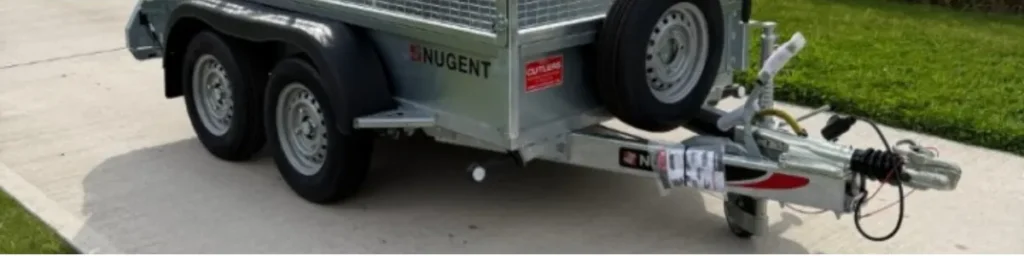
The main difference is straightforward. A single axle trailer has one axle and two wheels, while a twin axle trailer has two axles and usually four wheels. The additional axle changes how the trailer’s weight is supported and can influence its carrying capacity, manoeuvrability and maintenance requirements.
| Feature | Single Axle Trailer | Twin Axle Trailer |
| Manoeuvrability | Generally easier to move and position by hand | More resistance when turning tightly |
| Unladen weight | Often lighter in comparable designs | Usually heavier due to additional components |
| Payload | Depends on the trailer’s rated capacity | Depends on the trailer’s rated capacity |
| Towing characteristics | Can tow well when correctly loaded | May feel more settled in suitable configurations |
| Maintenance | Fewer tyres and axle components | Additional tyres and running gear to maintain |
| Purchase cost | Often more affordable for comparable specifications | Typically higher, depending on size and equipment |
| Common applications | Compact box vans, utility and smaller general purpose trailers | Larger box vans, plant trailers, tippers and flatbeds |
Neither configuration is necessarily more suitable for every job. A well-specified single axle trailer can be an excellent choice for regular use, while a twin axle model may provide the dimensions and carrying capacity needed for more demanding applications.

When Is a Single Axle Trailer the Better Choice?
One of the biggest advantages of a single axle trailer is manoeuvrability. With just one axle, there’s generally less resistance when turning, which can make the trailer easier to position in a driveway, yard or restricted working area.
This is particularly useful if you regularly need to move an unladen trailer by hand or store it somewhere with limited access. Single axle trailers also tend to have a lower unladen weight than comparable twin axle designs. Depending on the model, this can be beneficial where towing vehicle capacity is limited or a larger trailer simply isn’t necessary.
A Practical Choice for Smaller Loads
Single axle trailers are available in a variety of configurations, including enclosed box vans and smaller utility trailers.
For example, the Debon Roadster C220 is a compact single axle box van trailer available through Cutlers. With a maximum gross weight of 750kg and a payload of approximately 420kg, it provides an enclosed transport option for suitable tools, equipment and other relatively light loads.
Its compact design makes it worth considering for buyers who need weather protection and secure enclosed storage without the dimensions of a larger commercial trailer.
You can explore this and other models in our range of box van trailers.
Single axle trailers aren’t limited to occasional domestic use, either. Provided the trailer is correctly rated for the work, they can be a practical choice for businesses regularly transporting loads within their permitted capacity.

When Should You Choose a Twin Axle Trailer?
Twin axle trailers are commonly used where greater gross weight ratings, larger body dimensions or more demanding transport requirements call for a different trailer design. By supporting the trailer across two axles, manufacturers can produce models suited to a wide range of commercial and agricultural applications.
This is why twin axle configurations are frequently found on larger plant trailers, tipper trailers, flatbeds and enclosed transporters.
For example, the Nugent P3118H plant trailer has a maximum gross weight of 3,500kg and a listed payload of 2,730kg. It’s designed for transporting suitable machinery and equipment, where the trailer’s overall construction and carrying capacity are essential considerations.
Twin axle designs can also be useful for businesses that regularly transport larger loads over longer distances, although towing performance still depends on the trailer, towing vehicle and correct loading.
What Are the Trade-Offs?
The additional axle brings some practical considerations. Twin axle trailers are generally more difficult to manoeuvre by hand, particularly on firm surfaces where the tyres resist turning.
This effect, often called tyre scrub, occurs when the wheels cannot all follow the same turning path during a tight manoeuvre. It can make positioning the trailer more demanding and contribute to tyre wear.
Twin axle trailers also have more tyres, bearings and suspension components, with additional braking components where fitted. This can increase routine maintenance costs compared with a similarly equipped single axle trailer.
These aren’t necessarily reasons to avoid a twin axle model, but they’re worth considering if you don’t need its particular capacity or dimensions.

Does a Twin Axle Trailer Carry More Weight?
Not necessarily. Although twin axle trailers are commonly associated with heavier loads, the number of axles doesn’t tell you how much a trailer can legally carry.
The important figures are its maximum authorised mass (MAM), unladen weight and available payload. A trailer’s payload is the difference between its permitted maximum weight and its unladen weight. Adding an axle also adds weight, so a twin axle configuration doesn’t automatically mean a higher usable payload.
Consider two enclosed trailers from the Debon range:
Debon Roadster C220: A compact single axle box van with a 750kg maximum gross weight and approximately 420kg payload.
Debon Roadster C700: A larger twin axle box van with a 2,600kg maximum gross weight and approximately 1,895kg payload.
The C700 offers considerably greater carrying capacity, but this reflects its overall design and rated specification rather than simply having an additional axle. It’s also important to consider your towing vehicle. Even if a trailer is rated to carry a particular load, your vehicle must be suitable for towing the combination, and you must have the appropriate driving licence entitlement.
For a more detailed explanation, see our guide to trailer weights and towing capacities.
Stability, Manoeuvrability and Maintenance: What Matters Most?
Twin axle trailers are often described as more stable than single axle models, but the comparison isn’t quite that simple.
A well-designed twin axle trailer may provide a more settled towing experience in certain conditions, particularly when carrying loads suited to its capacity. However, axle count alone doesn’t determine towing stability.
Correct load distribution, noseweight, tyre condition, suspension design and towing vehicle compatibility all influence how a trailer behaves on the road. A correctly loaded single axle trailer can tow very well, while a poorly loaded twin axle trailer can still become unstable.
The same principle applies to durability. Twin axle trailers aren’t inherently longer-lasting simply because they have more wheels. Construction quality, operating conditions, loading and maintenance have a greater influence on service life.
From an ownership perspective, the main differences are straightforward:
Single axle: Usually easier to manoeuvre manually, with fewer tyres and running gear components to maintain.
Twin axle: Often found on larger, higher-rated trailers, but with additional components and greater resistance during tight turns.
If you’re choosing between two models, it’s worth comparing their actual specifications rather than assuming one configuration will always tow better or require less attention.
Which Axle Configuration Is Right for Your Trailer?
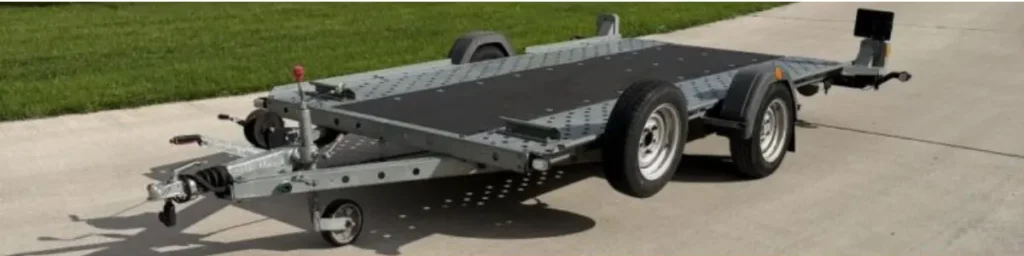
The type of trailer you’re buying will often help narrow down the decision. For smaller enclosed loads, a single axle Debon box van trailer may provide the space and protection you need without moving to a larger model.
For mixed agricultural, estate and commercial transport, our Nugent general purpose trailers offer a range of specifications worth comparing according to the loads you regularly carry. If you’re transporting machinery or equipment, the carrying capacity, dimensions and loading arrangements of a suitable plant trailer will usually be more important than choosing by axle count alone.
Ultimately, the right choice is the trailer that meets your requirements without adding unnecessary size, weight or running costs.
Find Single and Twin Axle Trailers at Cutlers Sales & Hire
At Cutlers Sales & Hire, we’re a family-run trailer dealership based in Derby, supplying trailers from established manufacturers including Debon, Nugent, Brian James and Cheval Liberté.
Whether you’re looking for a compact single axle box van or a larger twin axle trailer for commercial work, our team can help you compare the specifications and find a suitable model.
We can advise on payload capacities, trailer dimensions, towing compatibility and loading arrangements, helping you make an informed decision before buying. Explore our current range of trailers for sale, including box van, general purpose and plant trailers, or contact Cutlers Sales & Hire for advice on choosing the right trailer for your requirements.